Socialbrite Archives: March 2011
Ideavibes: A new way to do crowdsourcing & crowdfunding campaigns

Engage4change contest asks SF residents for ideas to improve housing & transportation
Editor’s note: A start-up called Ideavibes has created a crowd-engagement platform that can be purchased by nonprofits, government agencies or businesses to do their own crowd engagement or crowd funding. It’s one of the more interesting companies we spotted at Web 2.0 Expo this week.
Guest post by Paul Dombowsky
Founder & CEO, Ideavibes
As every nonprofit, business or government knows, the more engaged your constituents, the more likely they are to give or participate. What’s the best way to engage, then? A new technology, fresh on the market, promises to make it easier for people to participate and have their voices heard.
Ideavibes, a start-up based in Ottawa, Ontario and displaying at San Francisco’s Web 2.0 Expo (ending today), has developed a Crowd Engagement Platform that enables organizations to create crowdsourcing and crowdfunding campaigns. Nonprofits, municipalities and businesses can use the platform to engage a wide swath of constituents by seeking input or project funding in a highly visible and transparent interaction.
What we’re seeing is this: Participants feel involved, visible and acknowledged with the platform. When individuals can see their input or dollars recognized and valued, they are more likely to participate, and more likely to encourage others to follow suit.
The Ideavibes platform can be easily deployed on a current or a newly developed website built with the organization’s branding. The platform includes everything needed to run a crowdsourcing or crowdfunding campaign: Submit an idea, fund a project or make a donation and have the opportunity to comment and vote on the submissions of others. The immediate feedback of viewing their submissions provides participants an immediate public acknowledgement. They are further compelled to invite friends and family to support their idea or donation, to raise its visibility.
Engage4change, a crowdsourcing contest, kicks off
To demonstrate its crowd engagement platform, we’ve just launched Engage4change, a 14-day crowdsourcing contest focused on culling innovative ideas for improving housing and transportation in the city of San Francisco. It ends April 10. The idea that receives the most votes will be presented to San Francisco Mayor Edwin Lee on April 12, and the person who submitted it will be awarded $250.
Continue reading »
This work is licensed under a Creative Commons Attribution-NonCommercial 3.0 Unported.
0 Comments
10 media relations tips for your nonprofit

Follow these do’s and don’ts to get a better shot at press coverage for your event
Guest post by Cherie Louise Turner
Vivanista
Events benefit from media coverage. And seeing a story about your hard efforts or seeing photos of your fundraising event receiving coverage in social media and traditional media is satisfying and exciting.
Getting good media coverage is a challenge. But It can become much more rewarding, for you and your chosen media outlets, if you develop good relationships with their editors. Having been on the editorial side of the equation for more than a decade, I have dealt with a huge variety of approaches from those seeking my attention. Here are my top five dos and don’ts to creating great relationships with editors.
DO follow these steps
- Know the publication
It’s amazing how few people follow this simple rule. Consider: why would an editor be interested in working with someone who doesn’t take the time to know what her publication is about? It’s both a matter or respect as well as efficiency: if you know the publication, you’ll know what type of story about your event to pitch. A well thought-out and appropriate story idea is far more likely to be of interest to an editor. - Be mindful of an editor’s lack of time
Editors are often on deadline or juggling multiple projects; they’re busy just like everyone else, and it’s easy to catch them at a stressful time. So be efficient in your dealings. Yes, your event is important; it may be your top priority. But it’s only one of dozens of other things the editor is dealing with. Be mindful of her side of the situation, too. - Know what you’re looking for
There are three basic ways events get coverage: a calendar listing, post-event coverage/a story about the event itself, a story about someone or something linked to the event. Know what you’re looking for before you call or e-mail a publication. If you’re looking for story coverage, present some compelling storylines to follow. What’s inspiring, unique or newsworthy about your event? Give an editor something to work with, and you’re more likely to get in the publication. - Be politely persistent
It’s a good idea to make sure your materials reach the right person. Start the process by sending your materials via e-mail. If you haven’tWhat’s inspiring, unique or newsworthy about your event? Give an editor something to work with.received some sort of response within a couple of days, a polite follow-up e-mail is completely appropriate. E-mail gets lost or sometimes accidentally passed over; it’s OK to just ensure that yours actually got seen. If that second attempt doesn’t get a response, phone the editor. If you’re still not getting any response, make one last attempt and then move on. Editors are always looking for content; if you know they’ve seen your materials and they’re not responding to you, it’s safe to assume they’re not interested. Put your efforts into finding another outlet that is.
- Get materials in on or before deadlines
This applies both to your original press releases as well as any requested materials. Know when a publication starts planning its issues; know that some magazines plan months in advance. Time your submissions accordingly. If you are working with an editor who’s interested in covering your event, make sure she has everything she requests when she requests it. If you show yourself to be a reliable resource, you’ll be top on that editor’s list of people to work with again.
DON’T make these mistakes
- Don’t insist that your event or story idea is perfect for the publication
That’s the editor’s job; she knows her publication and decides what will work and what won’t. Offer the information, and share what you honestly believe will be of interest to the readers (and not just serve to be self-promotional). If there’s still no interest, move on.
0 Comments
FrontlineSMS founder wins award for software in public interest
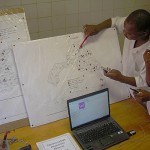
Ken Banks accepting the award at the Nonprofit Technology Conference. (Photo by JD Lasica)
Socialbrite partner Ken Banks honored at nonprofit conference
Guest post by Florence Scialom
Community Co-Ordinator, FrontlineSMS
Ken Banks, the founder of FrontlineSMS and a partner in Socialbrite, has been widely recognized for his work in giving grassroots groups the world over the capacity to interact, cheaply and simply, with people in remote communities via mobile. On Saturday, at the annual Nonprofit Technology Conference in Washington, D.C., Ken won the Antonio Pizzigati Prize for Software in the Public Interest.
The $10,000 Pizzigati Prize honors software developers who, in the spirit of open source computing, are fashioning exceptional applications for aid activists and nonprofits. Tides — a partner to philanthropists, foundations, activists and organizations worldwide — hosts the prize selection process.
Ken created FrontlineSMS because it speaks directly to a global communications reality: Millions of people in remote areas have no access to the Internet. But many of these millions do have simple mobile phones. FrontlineSMS enables grassroots groups to reach these millions, using only a laptop computer, a USB cable and a basic mobile phone or modem. And the constituents of these groups can use their own mobile phones to communicate back.
Continue reading »
This work is licensed under a Creative Commons Attribution 3.0 Unported.
0 Comments
New report: Nonprofit numbers for social media, advocacy, fundraising
Email outreach still dwarfs social media and mobile.
Benchmarks study: How does your nonprofit stack up?
At the Nonprofit Technology Conference in Washington D.C. the other day, I was one of 50 attendees who got a sneak preview of the fascinating 2011 eNonprofit Benchmarks Study, the big annual study that shows how nonprofits are using social media, email and much more.
You can download the free 36-page report from M+R Strategic Services and NTEN. The study — the fifth Benchmarks report — collected data about email messaging, email list size, fundraising, online advocacy, Facebook, Twitter and text messaging from 40 U.S.-based national nonprofit organizations for the calendar year of 2010. The study’s authors analyzed the results of 672 million email messages sent to over 17 million list subscribers; more than $114 million in online donations and 2.9 million advocacy actions.
Key fIndIngs of the report
- Online fundraising showed steady growth for participating groups in 2010 despite the current economic climate. Most groups saw a 10% increase in dollars raised online from 2009 to 2010.
- The 2010 advocacy response rate was 3.3%. From 2009 to 2010, advocacy response rates declined 7% on average.
- Not surprisingly, advocacy emails had the highest open, click-through and response rates while fundraising emails had the lowest click-through rate.
- Annual email list churn was 18%.
- Online fundraising revenue grew overall by 14% between 2009 and 2010. This rebound was led by an enormous 163% increase in the International sector due to emergencies like the earthquake in Haiti and flooding in Pakistan. However, all sectors saw an increase of some size in overall revenue from 2009, driven by an increase in the number of online gifts.
- On average, nonprofit Facebook Pages had 15,053 users, defined as people who “Like” a Page (but this includes large nonprofits).
- Facebook users were much more engaged with nonprofits in the Wildlife / Animal Welfare sector than in any other sector.
- On average, an organization’s text messaging list size was 1.9% of its email list size.
- Annual mobile list churn was 14% in 2010.
The graphic at the top of this article conveys, at a glance, why no one is suggesting that nonprofits abandon email marketing in favor of social media or mobile. For every 1,000 email subscribers for your nonprofit, you’ll have, on average, 110 Facebook fans, 19 Twitter followers and 19 mobile text subscribers. What those numbers don’t show, however, is that engaged fans on social networks, and connected fans on mobile devices, tend to be more loyal, to respond at higher rates to advocacy campaigns and to donate at higher rates than the average user.
Continue reading »
This work is licensed under a Creative Commons Attribution 3.0 Unported.
0 Comments
Photos from Nonprofit Technology Conference

NPR’s Moira Gunn and Rep. Donna Edwards, D-Md., at the end of their chat at 2011 NTC.
And a wealth of connections made — and introductions sought
Here’s my Flickr photo set from the Nonprofit Technology Conference held Thursday to Saturday in Washington, D.C. at the Washington Hilton — 89 photos in all. I got a chance to try out my new Canon 5D Mark II and 70-200mm lens.
It was the biggest (2,008 attendees, founder Holly Ross announced) and best NTC yet.
I’ll be writing several posts over the coming days and weeks about some of the highlights. I snagged video interviews with Mark Horvath of Invisiblepeople.tv, Jonathan Greenblatt of AllforGood and Ramya Raghavan of YouTube.
Other folks I met or got better acquainted with included:
• Jeanette Russell, Democracy in Action Continue reading »
• Brian Choc, Teaming for Technology Colorado
• Tim Lim & Matt Slutsky, Change.org
• Matt Mahan and Susan Gordon of Causes
• Randy Paynter, Care2
• Tatiana Marshall, Oceana
This work is licensed under a Creative Commons Attribution-NonCommercial 3.0 Unported.
2 Comments
Using location-based services for your nonprofit

The Feeding America campaign using geolocal.
On Saturday I was on a panel at the Nonprofit Technology Conference in Washington, D.C., discussing the use of location-based services to create awareness and raise money for your organization.
The panel included Estrella Rosenberg of Big Love Little Hearts, Joe Waters from Boston Medical Center, and Dan Michel from Feeding America.
Here are five points I took away from the session:
Understanding user motivations
1Understanding user motivations is important in developing your location-based service strategy. For example, Foursquare users love collecting badges and love becoming the mayor of a venue, while Places users are motivated by sharing interesting places and being on stage in front of their friends. Obviously, these are generalities – using them yourself is the best way to know what your constituents’ motivations are.
Use the services as is
2As you may have guessed, services like Foursquare and Gowalla don’t have the bandwidth to focus on special projects, or wish-list feature requests. With that in mind, develop your strategy around these services as they are – both in terms of user base and features.
Use them as one channel among many
3Because of the limited user base, cultural adoption and functional limitations of these tools, they should be used only as a marginal supplement to other channels. You might be wise to use them experimentally with no expectations of Return on Investment (and be pleasantly surprised when you have a win).
Continue reading »
This work is licensed under a Creative Commons Attribution-NonCommercial 3.0 Unported.
2 Comments
Google integrates its services for nonprofits

Nonprofts have been using Google tools to get some pretty amazing results!
For example, Direct Relief International raised more than $100,000,000 with AdWords. And the Natural Resource Defense Council got over 100,000 views on their YouTube videos by getting featured through YouTube’s nonprofit program – a huge win during last year’s BP oil spill.
On Wednesday Google launched an expanded offering of their tools and services so that nonprofits can apply for special status in one place — google.com/nonprofits — instead of having to apply separately for Google Grants, YouTube for Nonprofits and so on.
The offering includes:
- Up to $10,000 a month in Google AdWords to get more donors
- Free and/or discounted Google Apps
- Premium nonprofit features for YouTube and Google Mapping
- Educational videos
- Case studies
- Nonprofits Marketplace of partner services at free and/or discounted rates
Below is a short video with another example of how Samasource uses Google:
You can apply for the program here.
This work is licensed under a Creative Commons Attribution-NonCommercial 3.0 Unported.
One Comment
A story-driven Web platform for communities
Shelbyville project kicks off with a series of ‘Welcoming’ videos
Chances are you haven’t yet heard of Shelbyville, a small rural community in Tennessee, much less than the upcoming “Welcome to Shelbyville” documentary or the online project that is forging a pilot, or prototype, for communities to tell and share their own stories. So let me share my initial impressions of this remarkable, ambitious, exciting effort.
On Monday I was lucky enough to be a part of a “digital braintrust” of 20 progressive media and nonprofit representatives at the Bay Area Video Coalition headquarters convened by Active Voice, a San Francisco-based nonprofit that uses film, television and multimedia to spark social change.
We spent two hours reviewing the Shelbyville Multimedia project and offering ideas about how to finish it out and what to do differently next time. First, a quick overview:

Miss Marilyn, a retired public elementary school teacher who taught in Shelbyville for 34 years.
Active Voice conceived the vision of building a story-driven Web platform and brought together a team consisting of Free Range Studios, a creative services firm, and documentary filmmaker Kelly Whalen.
Over much of the past year, the parties combined efforts to create the ShelbyvilleMultimedia.org website while Kim A. Snyder directed and produced “Welcome to Shelbyville” (executive produced by the BeCause Foundation, in association with Active Voice) which has grown into an hourlong documentary that will air on ITVS’ “Independent Lens” series on PBS on May 24.
You can see the webisodes, produced by Active Voice in association with the BeCause Foundation, on the Shelbyville Multimedia channel on Vimeo. If you’re an educator, activist or community organization that wants to engage on a deeper level and host some of the webisodes on your own site or blog and invite conversations about the stories, head to the webisode discussion questions page.
What are your impressions? Please share your thoughts in the comments!
‘Shelbyville’: Stories about immigrant integration
The Shelbyville project is a series of stories about immigrant integration. One of Active Voice’s objectives was to introduce people to Welcoming America, an umbrella organization that works to promote mutual respect and cooperation between foreign-born and U.S.-born residents. It is overseeing “welcoming” initiatives in 14 states, including Welcoming Tennessee.
“They opened doors for us in Shelbyville and introduced us to other affiliates, who hosted community ‘sneak previews’ in October,” said Active Voice operations director Daniel Moretti.
Active Voice approached Irina Lee, the creator of First Person American, about working on a pilot based on the Welcoming Stories theme. The idea, Moretti said, was “to combine FPA’s aesthetic and authenticity with Active Voice’s need to attract user-contributed stories. We’re hoping to raise funds to keep going, to both send Irina to other cities, and to commission other artists to create new Welcoming Stories formats.”
You can see some of the Welcoming Stories on the Tumblr site created by Active Voice and Free Range.
The tone of the two sites is positive and uplifting. As Moretti told us: “We didn’t want to build an advocacy site but a site to help people take the next step by providing options for different levels of engagement.”
While the project took a lens to the issue of immigration in rural Shelbyville, Tenn., Moretti pointed out: “We’re media strategists, not immigrant integration specialists. We had a feeling that what was going on in Shelbyville would resonate with people in small towns and large cities across the country, and we’re eager to help them connect to these issues in a human and nuanced way. But Welcoming America is doing this important work for the long haul, and we hope the website will be a great vehicle for them.”
The story-driven Web platform that Active Voice and Free Range developed, then, is not just to showcase webisodes, parts of a documentary or even the story of Shelbyville. Active Voice sees it as an early pilot of how other communities can tell their stories in a deep, meaningful but easy and lightweight way, with the focus on individuals’ stories rather than forcing users to wade through a complex backstory.
Continue reading »
This work is licensed under a Creative Commons Attribution 3.0 Unported.
One Comment
3 social good conferences at Sustainatopia
Social Venture Capital & Media2Movements on tap
More than 300 speakers from 40-plus nations will participate in the second annual Social Venture Capital/Social Enterprise Conference and two conferences within a conference: Sustainable Haiti and Media2Movements, organized by Ashoka. They take place April 4-6 at the Miami Beach Convention Center as part of Sustainatopia, a gathering of social entrepreneurs and nonprofit leaders.
I’ll be speaking at two of them and, to kick off the first, my colleague Sloane Berrent will present a social media bootcamp — please check it out: Move the Needle! How to Mobilize Your Supporters to Take Action. (Email us for a 15% discount code.)
Discounts for early registration to the conferences expire today. See the agenda. We hope you’ll come on down!
Social Venture Capital/Social Enterprise Conference is the largest annual impact investment conference on the East Coast of the United States, Latin America and the Caribbean. Sustainable Haiti is the largest economic development conference in the world for Haiti, with more than 100 speakers and 40-plus panels over three days.
Sustainatopia Honors: Awards for social good

Patricia Arquette
Sloane and I will also be on hand at Sustainatopia Honors 2011 presented by Plum TV, an awards ceremony and celebration for those doing social good through impact investing and sustainability. It takes place the evening of April 3 at the swank new Frank Gehry/New World Center.
Honorees include Maria Bello, Selita Ebanks, Romero Britto, Michael Capponi, Americas Business Council Foundation and others. Special guests for the evening include actress Patricia Arquette and musician Tico Torres of Bon Jovi.
Some 60 individual events comprise Sustainatopia Miami, including film, art, music, eco-fashion, food, design and parties taking place on the weekend before start of the impact investment conferences. Sustainatopia will bring together thousands of individuals from over 50 countries, all seeking to make a profound difference and help push the world toward a more sustainable path.
This work is licensed under a Creative Commons Attribution 3.0 Unported.