 (925) 413-3870


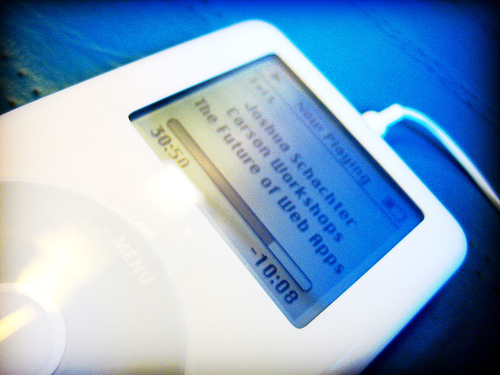
There are likely better ways to engage your supporters
Target audience: Nonprofits, NGOs, cause organizations, social enterprises, independent sites, educators.
By Kyria Abrahams
Socialbrite staff
 The human-interest work done by nonprofit organizations naturally presents a rich trove of compelling topics for the world of social media. In addition to Twitter and Facebook, podcasts may appear to be an effective way to push a good story to the public and generate interest for your cause.
The issue is this: Few people listen to podcasts anymore. And if they do, it’s nearly impossible to measure.
“Podcasts were a moment in time,” said Matthew C., who works as the global marketing specialist for an international nonprofit in New York. “iTunes automatically downloads everything [you subscribe to]. So we see you downloading. The question is: Are people listening? We have no way of knowing if the public is actually engaging with the content.”
Perhaps this is why the top five results for the search term “Top nonprofit podcasts” brought up links from as far back as 2006. Or why when I told Matthew that I was writing an article on podcasts, his immediate response was: “Choose another topic.”
Where did podcasts go? Should your organization should destroy all existing podcasts and never utter the words mp3 and iTunes again?
The eight-tracks of the Internet?
At the 2009 Blogworld and New Media Expo conference, podcasting pioneer Leo Laporte famously declared, “Podcasting is dead.” That’s a bit of hyperbole, considering that Laporte’s 23 podcasts are downloaded more than 5 million times a month. But Laporte has an established brand in tech circles, and it’s a challenge for newcomers to match those stats.
 If there’s no way to measure who is interacting with your podcast, why do websites like NPR and UNICEF.org still have popular podcast sections that are updated on a regular basis? You may be asking yourself: if they’re doing it, why shouldn’t we?
The answer is simple. Those podcasts are just another way to publicize a brand’s deeply embedded radio presence.
“If you have existing radio programs, there’s no reason that you shouldn’t podcast them,” said Matthew, who preferred that we not disclose his full name. “It takes five seconds.”
UNICEF, for example, augments existing news stories on their high-traffic website with radio reports, which, in turn, also go out as podcast episodes.
The difference between podcasting today and podcasting in 2006 is that podcasts are no longer thought of as a means to an end. Now, they’re just another way to get your story heard, like linking to an existing story on Twitter. Launching a podcast as a means to an end in 2011 is like starting a blog in the hopes of getting a book deal.
“A few years ago, it was thought that people would wake up in the morning and download their favorite podcasts onto their iPod for the morning commute,” Matthew continued. “Turns out no one actually uses their phones that way.”
That’s overstating it — certainly many podcasts have a dedicated listenership and fan base. But the real question is: In a resource-strapped organization, is this the best way to allocate your time?
There’s a lot of work that goes into creating something that looks so simple. The shorter the final piece is, the more work probably went into making it. That’s why it’s all the more important to make sure your podcast is part of a bigger social media campaign or program. If you do launch a podcast, some good podcasting hosting services include Libsyn, PodBean and SoundCloud.
So, bottom line, podcasts aren’t dead, but you probably shouldn’t start one with the hopes of going viral.
What happened to podcasts?
• People generally don’t use their media devices that way.
• No one can measure if people are listening to the downloaded podcast.
• The time and cost of creating one generally outweighs the benefits.
What’s your view? Disagree? Agree? Tell us in the comments!
Image at top on Flickr by Luis Villa del Campo


 This work is licensed under a Creative Commons Attribution 3.0 Unported.




Somebody has declared podcasting dead at least once a year since 2005, usually as linkbait.
I’d think the answer to “Should your non-profit produce a podcast?” would have to be “It depends.” Where do the people you want to reach hang out on the Internet? What do they do there? Are they already podcast listeners? It’s true, podcasting is no longer flavor of the month and people are not jumping onto that bandwagon trying to get rich quick. Yet there are still individuals and companies who start new audio podcasts and get great business results from them.
Yes, it is labor-intensive to produce a good podcast. No, it may not be the best use of your non-profit’s resources. But it’s also possible that jumping on the bandwagon of whatever is flavor of THIS month is ALSO not the best use of your organization’s resources. Everybody carries on and on and on about video, and most people use it as badly as they use PowerPoint. Many people seem to ignore the possible bandwidth and data transfer issues, not of the donors to their causes, but of the people they are trying to help.
As Christopher S. Penn likes to say, you have to test. Find out what’s ACTUALLY going to work for YOUR market, rather than following the trends and what the gurus are saying. You might have a constituency for whom SMS text messaging is the most effective means of communication, even if it’s not at all trendy, because people have phones, mostly older phones, and not computers.
And you might be working with people who don’t have time for video and think Facebook and Twitter are for kids, but who would listen to a podcast while commuting.
Thanks, Sallie, good points! Certainly there are valuable podcasts out there that speak to important target audiences, so that should be a primary consideration for any organization. And as you say … research, then test!
If folks in the nonprofit community are having success with your podcasts, we’d love to hear your stories and why you think it’s working well.
I’m with Sallie. Just like you can’t say that every nonprofit should have a Facebook Page, or a Twitter feed, or a blog, or a YouTube channel, you can’t say that none of them should have podcasts.
The key is to ask the same questions you’d ask when deciding about any social media tool:
1. What is your goal?
2. Who are you trying to reach?
3. What kind of content do you have, or want to share?
4. How much time do you have?
5. How much tech expertise does your staff have?
6. What’s your budget?
A podcast may be the appropriate answer to those questions.
I also agree with Sallie that you have to test. In the case of producing a podcast, you can experiment with kinds of content, show length, hosts, music, listener participation, and distribution format (e.g. online player, iTunes subscription, iPhone app., transcription) to see what resonates the best with your audience.
I still think Podcasts are a great way to go. People can do their work while listening to something and intersperse it with music. What’s wrong with that
I used to teach podcasting. So did my social media colleague Eric Schwartzmann. Neither of us does anymore as interest has fallen off. This article is a reflection of the reality that podcasting for smaller organizations hasn’t lived up to the rah-rah hype of the early days. When I go into resource-strapped nonprofits today and see all that they need to do, and we come away with a “Top 5 Things To Do” List, podcasting hasn’t been on any of them.
Having said that, every nonprofit has different needs and they need to prioritize. For some, podcasting may be a good choice. It’s a matter of what tools help you achieve your organizational goals.